Wasps in Texas: The Essentials
You step onto the patio and see a wasp slip beneath the roofline. A few minutes later, another one heads for the same spot. If you are searching for information about wasps Texas homeowners commonly encounter, start by looking at where the insects are going and what their nest looks like.
Texas homeowners may encounter paper wasps, yellowjackets, mud daubers, cicada killers, and bald-faced hornets. Some protect social colonies and readily defend a nest, while others live alone and rarely create the same sting risk. This guide covers the common types of wasps in Texas, their nests, sting concerns, seasonal activity, and when professional control makes sense.
What Types of Wasps Are Common in Texas?
Several Texas wasps spend time around homes without causing a serious problem. You might see one collecting nectar from flowers or hunting other insects in the yard. Repeated traffic into the same eave, ground hole, or wall opening deserves a closer look from a safe distance.
The Texas A&M AgriLife Extension describes paper wasps as one of the most common wasps around homes and buildings in the state. It also separates social wasps that defend shared colonies from solitary species that mainly use their stingers to catch prey.
| Wasp | What You May Notice | Typical Nest | Concern Around a Home |
|---|---|---|---|
| Paper wasp | Slender body, often reddish brown or brown with yellow markings | Open paper comb under eaves or covered surfaces | Can sting repeatedly when the nest is disturbed |
| Southern yellowjacket | Compact black and yellow body | Underground cavity, wall void, shed, or protected space | Strong defense around an active colony |
| Mud dauber | Long, narrow waist with dark or metallic coloring | Tubes or clumps of dried mud | Usually mild-tempered unless handled |
| Cicada killer | Very large body with dark and yellow markings | Individual burrows in soil | Females can sting, but encounters are usually brief |
| Bald-faced hornet | Black body with white markings | Enclosed gray paper nest above ground | Defensive when people approach the colony |
Paper Wasps and Red Wasps
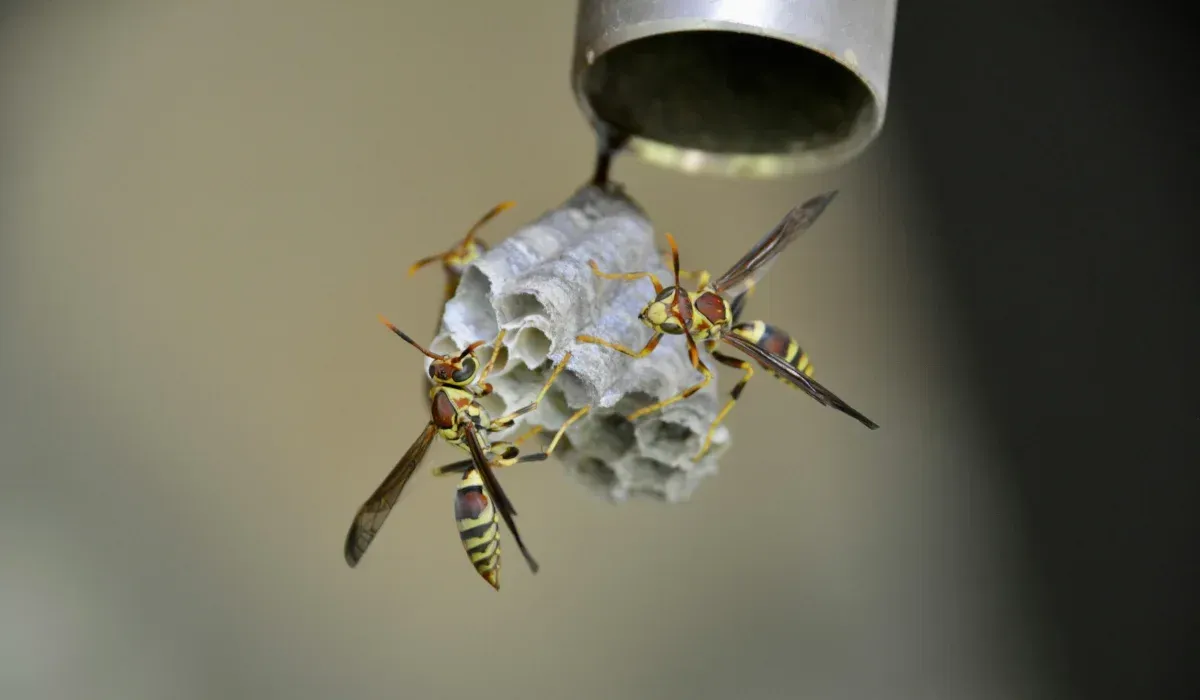
Paper wasps in Texas often build under porch ceilings, roof overhangs, sheds, play structures, and other sheltered surfaces. Their nests have exposed hexagonal cells, so the finished structure can resemble a small upside-down umbrella.
A typical mature nest contains about 20 to 30 adults and rarely exceeds 200 cells. The reddish-brown insects many homeowners call red wasps in Texas are part of the paper wasp group. If you repeatedly see one returning to an eave or porch ceiling, an open comb may be nearby.
Southern Yellowjackets
Yellowjackets in Texas tend to be shorter and stockier than paper wasps. You may notice their flight pattern before you get a good look at the insect. Several wasps entering and leaving one hole in a lawn, flower bed, or exterior wall can point to a hidden colony.
Some southern yellowjacket colonies become unusually large. Texas records include nests measuring 6 feet or more across and exceptional colonies with as many as 20,000 adult workers. Those figures represent the upper end, not the average backyard nest, but they show why a small entrance can hide much more activity below ground or inside a structure.
Mud Daubers and Cicada Killers
Mud daubers create one of the easiest wasp nests to recognize. Look for dried mud tubes or clumps attached to a wall, eave, shed, or other protected surface. These solitary wasps hunt spiders for their young and do not have hundreds of workers defending the same nest.
A cicada killer wasp is much larger and can reach about 1.5 inches long. Females dig individual burrows in lawns, gardens, and flower beds, then stock them with cicadas for their developing young. Males sometimes hover close to people, but they cannot sting.
How Can You Identify a Wasp Nest?
Good wasp identification does not require getting close enough to study body markings. Watch the insects from a distance and note where they disappear. Their nest structure and traffic pattern can often narrow down the species faster than color alone.
Around Austin and San Antonio homes, check roof eaves, porch ceilings, sheds, garages, shrubs, trees, flower beds, exposed soil, and exterior wall openings. Stay far enough away that the wasps continue their normal movement instead of reacting to your presence.
| What You See | Most Likely Wasp | Common Location |
|---|---|---|
| Open comb with visible cells | Paper wasp | Eaves, porches, sheds, protected fixtures |
| Several wasps using one ground opening | Yellowjacket | Lawn, garden bed, slope, embankment |
| Steady traffic through siding or a wall gap | Yellowjacket or another cavity-nesting wasp | Exterior wall, garage, structural void |
| Dried mud tubes or clumps | Mud dauber | Wall, eave, shed, attic |
| Separate soil holes with loose dirt nearby | Cicada killer | Lawn, garden, flower bed |
| Large enclosed gray paper nest | Bald-faced hornet | Tree, shrub, elevated protected area |
Watch the Traffic Pattern
One wasp crossing your yard may simply be looking for food. Several insects using the same entrance every few seconds give you much stronger evidence of an active nest.
The same applies to wasps entering siding or another structural gap. Do not plug an active opening before the colony has been addressed. Wasps trapped inside a wall can search for another exit, including a route toward the interior of the house.
Which Texas Wasps Are Most Likely to Sting?
Paper wasps and yellowjackets deserve more caution around their nests because they live in social colonies. Workers defend the nest and developing young, so normal activity near an entrance can trigger a response even when nobody intentionally bothers the insects.
Location plays a large part in the risk. A nest high in a tree may never affect your routine. Place that same colony beside a front door, patio chair, children's play area, or lawn that you mow every week, and accidental encounters become much more likely.
Where the Nest Sits Matters
Think about how often you use the area around the nest. This is usually more useful than trying to label every wasp you see as aggressive or harmless.
| Situation | Practical Concern | Why |
|---|---|---|
| One wasp feeding on flowers | Low | The insect is away from its nest |
| Mud dauber on an unused shed | Usually low | No large colony is defending the site |
| Cicada killers around separate burrows | Usually low | Females rarely sting unless handled, and males cannot sting |
| Paper wasp nest beside a door | Higher | People repeatedly pass close to the colony |
| Yellowjacket nest beside a lawn or walkway | Higher | Footsteps, pets, and equipment can disturb the nest |
| Wasps entering a wall | Higher | The colony's size and exact location are hidden |
A lawn mower can disturb an unnoticed ground nest before you know it is there. A dog investigating a hole or a child running across the same patch of grass can do the same. With ground-nesting wasps, spotting the entrance early can help you avoid an unexpected encounter.
How Serious Can a Wasp Sting Be?
Most wasp stings cause immediate pain, redness, and swelling around the sting site. Wasps can also sting more than once because they normally retain their stinger after striking.
Severe reactions are uncommon but can become medical emergencies. The Centers for Disease Control and Prevention (CDC) recorded 788 U.S. deaths from 2011 through 2021, an average of 72 per year. Annual deaths ranged from 59 to 89, and 84% occurred among males. The figures combine hornets, wasps, and bees rather than counting wasp stings alone.
If a sting is followed by trouble breathing, faintness, widespread hives, or swelling around the mouth, tongue, or throat, get emergency medical care. In their guidance for insect stings, the CDC and National Institute for Occupational Safety and Health (NIOSH) identify severe allergic reactions as emergencies that require immediate treatment.
Why Does Wasp Activity Change Through the Year?
A paper wasp nest that looks tiny in spring can become much busier as the season progresses. Queens establish colonies, the first workers mature, and those workers take over more of the food gathering and nest building.
Yellowjacket colonies follow a similar cycle. Their populations grow through summer and generally reach their largest size around August or September in Texas. That helps explain why a ground opening or wall gap that attracted little attention earlier in the year can have steady wasp traffic later.
Why Your Home Can Attract Wasps
Homes provide many of the protected spaces wasps use naturally. Roof overhangs keep exposed nests out of direct rain, while wall voids, sheds, and other cavities provide shelter for species that prefer enclosed spaces.
Your yard supplies food and nesting material. Flowers provide nectar, other insects provide prey, and patches of suitable soil give burrowing wasps somewhere to dig. Open trash or food left on the patio can also draw scavenging yellowjackets.
What Should You Do When You Find a Wasp Nest?
Start with the nest location. A mud dauber nest on the back of a detached shed may never interfere with your day, while an active yellowjacket entrance beside the sidewalk puts people within a few feet of the colony again and again.
Do not hit, shake, knock down, or seal an active nest before you know what is inside. Underground colonies and wall nests can extend well beyond the visible entrance, which makes DIY wasp nest removal harder to judge than an exposed paper comb.
When You Can Consider Leaving It Alone
Not every wasp around your property needs to be removed. Mud daubers hunt spiders, cicada killers hunt cicadas, and other wasps feed on insects that homeowners may consider pests.
Ask whether you can use your doors, patio, lawn, and walkways without repeatedly passing close to the nest. If the colony is out of the way and nobody needs to enter its defensive area, leaving it undisturbed may be reasonable.
When Professional Wasp Control Makes Sense
Professional wasp control becomes more useful when the nest is underground, hidden in a wall, high above the ground, or difficult to identify. Repeated wasp activity beside doors, patios, play spaces, or lawn equipment also increases the chance that someone will disturb the colony accidentally.
A known severe sting allergy is another reason not to experiment with DIY removal. If you cannot see the full nest or safely reach the area, getting rid of wasps is less about finding a stronger spray and more about locating the colony correctly.
Get Help With Wasps Around Your Texas Home
The safest response starts with knowing what is there. Paper wasps build exposed combs, yellowjackets often disappear into ground openings or structural cavities, mud daubers leave mud tubes, and cicada killers dig individual burrows. Once you recognize the nest and its location, you can make a more informed decision about whether it needs to be removed.
Professional service makes sense when wasps are nesting in an area you use often or when the colony is hidden where you cannot assess it safely. An experienced technician can identify the insect, locate the nesting area, and choose an approach suited to the type of nest rather than treating every wasp problem the same way.
EcoForce Pest Management provides wasp control throughout the Austin and San Antonio metro areas. If you are seeing repeated wasp traffic, have a nest close to a high-use area, or cannot tell what is living inside a wall or underground, contact EcoForce Pest Management for an inspection and treatment recommendation.
Start Being Pest Free Today!
Contact Us